Mechanical oscillator
Tesla's Oscillator: What Was Real, What Became the Earthquake Machine
The oscillator was not a meme. It was a real family of Tesla machines: reciprocating engines, electric generators, and high-frequency experimental tools. The earthquake-machine legend came later and needs firmer handling.
What the oscillator was
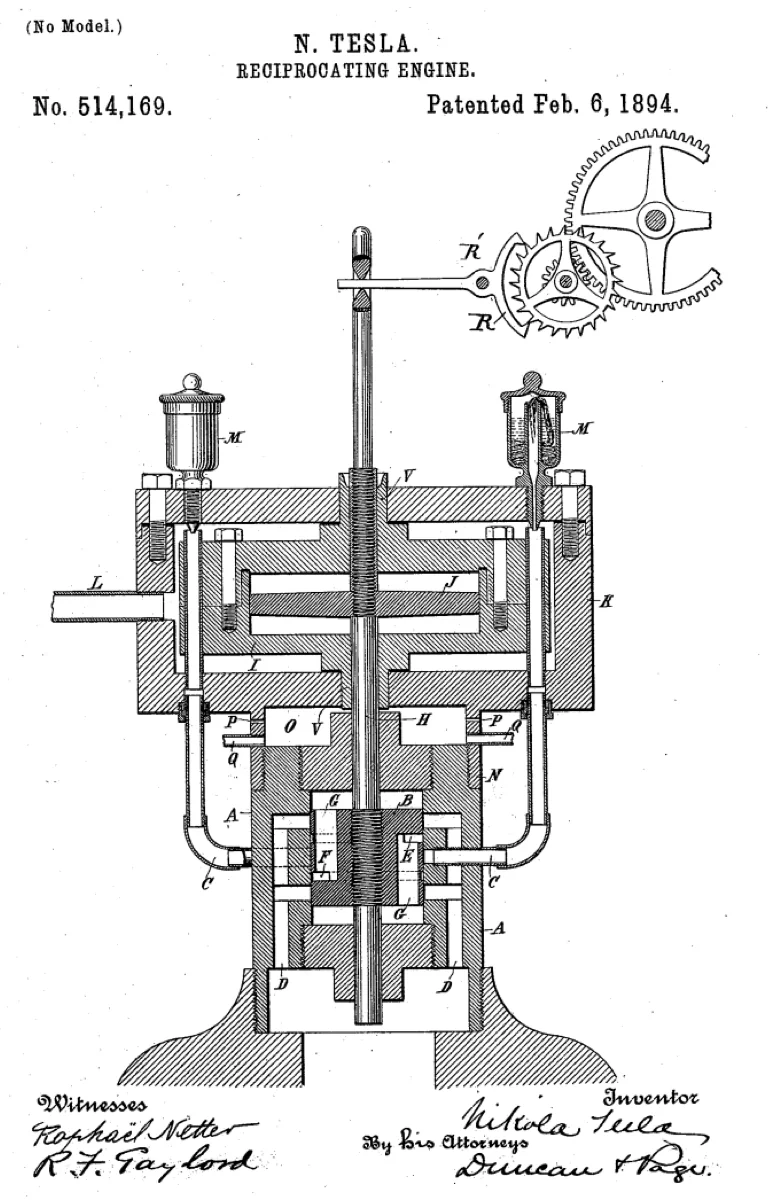
The object usually called Tesla's mechanical oscillator was not one single machine. It was a cluster of designs around rapid reciprocating motion. In U.S. Patent 511,916, Tesla described an electric generator in which a piston rod caused a magnetic element to vibrate in a field. In U.S. Patent 514,169, he described a reciprocating engine whose regular motion was governed by a spring-like system, including the compressed air behind the piston.
The practical target was constant-period motion. If an engine could reciprocate with great regularity, it could become a stable source of mechanical vibration and, when coupled to a magnetic system, a source of electrical current. That is why the 1895 reporting focused on steadiness: the oscillator was interesting because it could maintain a regular rhythm.
What it was not
Nothing in the oscillator patents turns it into a 3-6-9 numerology device. The claims are mechanical and electrical: pistons, valves, springs, magnetic cores, coils, current, and period. That distinction matters because the modern internet often collapses every Tesla frequency topic into one mystical package. The source record does not support that merge.
Tesla did think in terms of oscillation and resonance. That is not the same as saying he taught a hidden law of reality based on three digits. A useful reading of the oscillator begins with ordinary engineering vocabulary: period, damping, load, spring response, and electrical output.
Primary patent
Electric generator, 1894
Direct coupling of reciprocating engine motion to a generator element.
Primary patent
Reciprocating engine, 1894
A pressure-driven piston controlled by an elastic or air-spring vibration.
Contemporary article
Century Magazine, 1895
Public laboratory account presenting the oscillator as an instrument of steady frequency.
Mark Twain, the lab photograph, and the story people remember
Mark Twain did visit Tesla's laboratory, and the famous 1894 photograph is real. IEEE Reach identifies the scene as Twain holding one of Tesla's experimental lamps in the lab, with Tesla visible in the background, and ties the image to the Century Magazine oscillator coverage. That photograph is often used to decorate later stories about a vibrating platform.
The Twain anecdote is a reminder to separate visual evidence from story evidence. A photograph can prove that Twain was in the lab. It does not prove every later detail attached to the oscillator, especially comic versions of the story that circulate without clear contemporary sourcing.
The earthquake-machine claim
The dramatic version says that a small oscillator caused buildings around Tesla's Houston Street laboratory to vibrate, drew police attention, and had to be stopped. The story is famous because it fits a powerful engineering intuition: drive a structure near resonance, and small impulses may grow into large motion. That intuition is real. The historical proof for a city-shaking device is much thinner.
The strongest dated public source for the later claim is the 1935 birthday press coverage. The New York American story, transcribed as "Tesla's Controlled Earthquake", reported Tesla's discussion of transmitting mechanical vibrations through the earth. It framed the system as telegeodynamics, a possible communication and detection method, and a potentially destructive force in war.
"controlled earthquake"
This two-word phrase is from the 1935 New York American framing, not from the 1894 patent documents. That date difference is the key to reading the claim responsibly.
Documented, plausible, unsupported
A clean summary is this: the oscillator is documented; resonance effects are physically plausible; the spectacular earthquake-machine result is unsupported as a verified public demonstration. Tesla may have performed experiments that shook parts of a lab or structure. It is much harder to move from that to "Tesla built an earthquake machine" without adding more evidence than the record supplies.
That restraint does not diminish Tesla. It makes the real work more interesting. Tesla was trying to produce steady oscillations, to generate currents, to explore high-frequency effects, and to push communication beyond wires. Those goals belong to engineering history. The earthquake label belongs to legend unless it is pinned to dated, checkable sources.
Where to go next
To understand why the story is tempting, read the real physics of resonance. To understand why it gets mixed with number mysticism online, read the 3-6-9 myth. To put the oscillator in Tesla's broader electrical program, read wireless and frequency.